Norwegians say takk in more situations and differently than you might expect. Learn when to use expressions like takk for sist, takk for maten, selv takk — and why you should be careful with takk for alt.
Got some feedback? Write me :)
🧩 Want to supercharge your Norwegian?
Join The Norwegian Puzzle Premium for premium episodes, graded listening (from total beginner to advanced), transcripts, pedagogical resources, and more.
👉 Explore Premium: https://podcast.norsk-med-silje.com/
🌐 More from Norsk med Silje: https://www.norsk-med-silje.com/
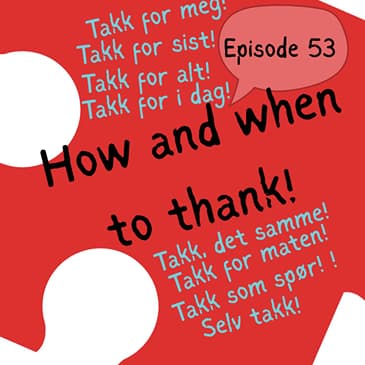
Hello, I have a cold again, but I hope my voice is okay. I thought about the fact that in Norway we have many different ways of thanking. Not different ways of thanking, but we thank in contexts where maybe others wouldn't. And these expressions that we use are not necessarily easy to understand when to use. So I thought I'd give you a small introduction to expressions we use when we thank and when you can use them. The first one I want to say is takk for sist. Or if I take it word by word, it's takk for sist, which literally means thanks for last. And we've skipped the word time, thanks for last time. And this is used when the person you meet, the last time you met that person was for a special occasion. For instance, you were at a dinner or a party, a gathering somewhere, julebord. So it was something special. You don't say it when you meet your colleague the day after a just regular work day. So that's when you can use takk for sist. Or if I say it quickly, takk for sist. With a skarre R or a French R, I would say takk for sist. Takk for sist. Okay, next one. After a meal, we usually say takk for maten. Or when I say it quickly, the R in for disappears. Takk for maten. Yeah, if I say it really quickly, the E in front of the N also disappears in the end. Takk for maten. Takk for maten. So who says this to who? Actually, everyone says this. It doesn't matter if you're out on a restaurant, you can say it to each other. Or if you organize a dinner, you can also say that to your guests when you're done. Because you're not thanking someone for making the food, you're thanking the people for sharing the food with you. So that's why we say it. Thanks for the food. It literally means but we're thanking for sharing the meal, basically. When you're leaving, if you are at someone's place, the thing you say when you leave is or can be takk for meg. Takk for meg. Takk for meg. Takk for meg. Takk for meg. The R in for disappears when you say it quickly. It's like saying thanks for having me. Takk for meg. If you're two people or more leaving together, then you can also say takk for oss. Takk for oss. Thanks for us. Especially if one of you are, if you have a kid with you, right, because the kid will not say thanks. So you're thanking for the kid. And then as a response, the person who invited you can say takk for besøket. Takk for besøket. Takk for besøket. Thanks for the visit. When you say takk for meg, so thanks for me or thanks for having me, you say that basically when you're leaving somewhere. So you can also say that, imagine you're, if you have a speech, I don't know, at a wedding, for instance, and then when you're done, you can say takk for meg. Thanks for listening or thanks for having me. Another possibility is takk for at du kom. Takk for at du kom. Takk for at du kom. Thanks for coming or literally thanks for that you came. Because we don't say coming, that doesn't exist in Norwegian. So thanks for that you came, for the fact that you came. So, yeah, at can mean the fact that. Just the word at can mean the fact that. All right, what else do we have? Oh, yeah. So if somebody asks you, how's it going, for instance, hvordan går det? You can answer takk som spør. Thanks who asks. Thanks for asking. I think it's a short version of thanks to you, who is asking. We're just saying thanks who is asking. Takk som spør. Takk som spør. I could also say takk for at du spør. Takk for at du spør. Thanks for the fact that you're asking. Just like with thanks for coming, right? Takk for at du kom. Thanks for coming. Takk for at du spør. Thanks for asking. If you want to say thanks for the ride, you can say takk for turen. Takk for turen. Takk for turen. Takk for turen. So tur is a word that can mean so many things. So you can use it to say thanks for the ride, thanks for the walk, thanks for the trip. It's all of that. Tur is a ride, a trip. It's all kinds of trips, I guess. A walk trip, a car trip, a flight trip, right? You can add anything to it. Biltur, fjelltur, en gåtur. So yeah, just to say that takk for turen can be used in many contexts. If you have been traveling with someone, takk for turen. Takk for turen. Or you've been on a hike, takk for turen. Or a ride, a car trip, takk for turen. And you've probably noticed that I pronounce it in two different ways. I can either say turen, turen, like when I say morgen, morgen, morning, turen, or turen, which meght be easier, but turen is quite normal to say. We also say sometimes takk for i dag, takk for i dag. Thanks for today. And that meght seem straightforward, but we don't, you can't use it whenever you want just to thank someone for the day you spent with them. Doesn't work like that. Takk for i dag, it means, it's a way of saying goodbye. This is the end of something and we will meet again because it's just today and there will be another day. And this is used for instance, after work day. So this is just one day of many days. So that's what you're, that's why we say thanks for today. Today was one day, yesterday was another day and tomorrow will be a new day. So it's just thanking for one of all of the days that we're working together. You can also use that when you're, when the class is over. That's what I say when the class is over. I say takk for i dag. And also in the end of, I think I say it in the end of the podcast as well sometimes. Takk for i dag means that the session is over. See you next time. That's what it basically means. Takk for i dag. So next time you quit work and you want to say bye to your colleagues, you can say takk for i dag. You don't even have to say bye. Takk for i dag. You probably heard this one before, but I wanted to mention it anyway, just in case, because it can be, it can be funny if you say it when you shouldn't. Takk for alt. This is a sentence you don't want to say. Takk for alt. Unless you're at a funeral. Because literally you're thanking for everything, like everything, which means if you can thank for everything, then the person must be dead. Because everything would also be the future. And this person doesn't have a future. So then you can actually thank for everything. But if you really want to thank someone who has helped you a lot, for instance, don't say takk for alt, but precise. All what? All the help? Takk for all hjelpen. Or just takk for hjelpen. Thanks for the help. Takk for all hjelpen. Thanks for all the help. Or whatever you are thanking for. Takk for alle tingene. Thanks for all the things. Morbid. This is also something you can say if somebody says thank you to you and you want to thank them back. You can say, like, you feel like you should thank them instead, right? They're thanking you for helping them and you feel that you should also thank them because they also helped you. You can say, selv takk. Selv takk. Selv takk. It means thanks back to you. You also deserve a thank you. Selv takk. And if you want to thank someone for a compliment, for instance, and then you want to give them the same in return. For instance, du snakker godt norsk. And you want to say thank you. Same to you. You can say, takk det samme. Takk det samme. Takk det samme. Thanks the same. Or thanks likewise. And if you've been with people, maybe at a conference or it's the end of something and you don't know when you will see them again. It doesn't have to be professional. It can also be friendship. You're meeting up with friends and then you don't know when the next time will be. You can say, takk for nå. Takk for nå. Thanks for now. And that's a way of, yeah, thanking and saying, I don't know when we'll see you next, but we'll meet again. Takk for nå. Or you can also say, takk for denne gang. Takk for denne gang. Literally means thanks for this time. But it also means that I don't know when next time will be. Takk for denne gang. So this is the end of something and who knows when next time will be. So a lot of meaning in short sentences that seem quite obvious. Okay, so let's go through them quickly. So we had takk for sist. Thanks for last time. Something special happened. It was nice. Takk for maten. Thanks for the food. Thanks for sharing the food with me. Takk for meg. Thanks for me. Thanks for having me. Or takk for oss. Thanks for us. Thanks for having us. Takk for besøket. Thanks for the visit. Thanks for passing by. Takk for at du kom. Thanks for coming. And then don't say takk for alt. Thanks for everything. That means that the person is dead. Be more specific. What exactly are you thanking for? For instance, takk for all hjelpen. Thanks for all the help. Takk for alle tingene. Thanks for all the things. What else do we have? Yeah, when you're thanking back, you feel that they also deserve a thank you. You can say selv takk. Like thanks for helping me. Same to you. Thanks for helping me. Selv takk. I also want to thank you for some reason. Selv takk. And then if you want to say thanks likewise. Takk det samme. Thanks the same. Likewise. Same to you. The same compliment to you. Takk det samme. And I think that was it. Good luck with that. Make a small list so you can remember all of these and try to imagine in which context you could use them so you can actually apply them because thanking is so nice to do and we don't do it enough, I think. I know Norwegians thank in situations that meght be unusual to you, but I think you'll enjoy using these expressions. And since Norwegians aren't very, very polite in general, I would say, or at least they are polite but in their own way, adding some politeness spice is not such a bad idea, I think. So, with all that being said, takk for i dag. Takk for at du lyttet. Thanks for listening. Ha en fin dag. Vi høres.